Friday, 24 December 2010


Monday, 13 December 2010
CWDC – or some ‘other’, surely its business as usual for our fantastic foster carers?
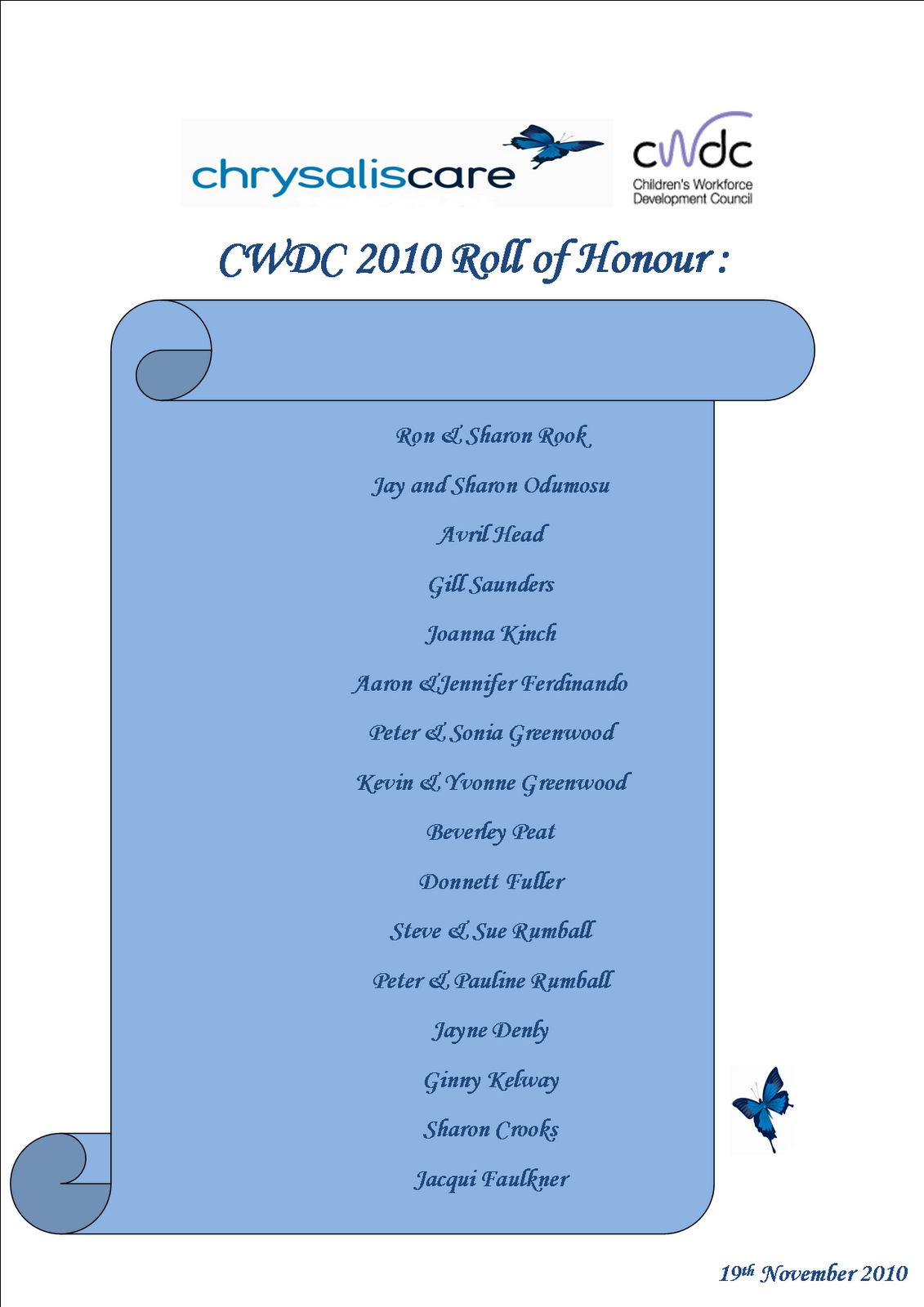
A number of our fantastic foster carers have now achieved their CWDC training, support and development standards and I continue to be impressed with the way Chrysalis Care foster carers remain committed to their learning and development. A treat on the day that we held an event to award CWDC certificates was the presence of our local MP David Evennett, who came to visit our head office in Bexleyheath, see http://www.flickr.com/photos/bexleyheathcrayford/5189853774/ for more on this.
Perhaps the involvement of local government is wholly appropriate in the current climate of devolved services. Although some of us may want to shield our eyes and our ears to the role of the government in what we do, there is a need (and a value) in acknowledging politicisation. To not consider agendas – such as notions of the ‘Big Society’ – is to not take on board everything that affects our current and future practice. In particular in relation to the CWDC, some significant changes to its organisation will undoubtedly affect, albeit even confuse us!
For those who have been around in the sector for some time, we are used to new standards, new milestones and in how these changes can sometimes cause some misunderstanding about what we are ‘supposed’ to do. This time is no different. I have received a little flurry of emails from people showing me the news about CWDC and asking if this means we can ditch the work books now (!). Some others have been concerned that they will have to rewrite their training programmes.
I say we carry on ‘as we were’ – the work is the same work, children and young people still need to be cared for in good, nurturing and stable homes. Foster carers still need to work within a framework that guides their good (and very, very good – outstanding even!) practice.
As we have learned from some of the changes to language over recent months, some of this is merely semantic and everything else remains essentially the same. In the case of CWDC, whether it is them or some ‘other’, something is necessary - to give credit to and reflect the fantastic role that Chrysalis Care foster carers have in transforming the lives of children and young people.
Jo Oliver
Service Development Manager
Perhaps the involvement of local government is wholly appropriate in the current climate of devolved services. Although some of us may want to shield our eyes and our ears to the role of the government in what we do, there is a need (and a value) in acknowledging politicisation. To not consider agendas – such as notions of the ‘Big Society’ – is to not take on board everything that affects our current and future practice. In particular in relation to the CWDC, some significant changes to its organisation will undoubtedly affect, albeit even confuse us!
For those who have been around in the sector for some time, we are used to new standards, new milestones and in how these changes can sometimes cause some misunderstanding about what we are ‘supposed’ to do. This time is no different. I have received a little flurry of emails from people showing me the news about CWDC and asking if this means we can ditch the work books now (!). Some others have been concerned that they will have to rewrite their training programmes.
I say we carry on ‘as we were’ – the work is the same work, children and young people still need to be cared for in good, nurturing and stable homes. Foster carers still need to work within a framework that guides their good (and very, very good – outstanding even!) practice.
As we have learned from some of the changes to language over recent months, some of this is merely semantic and everything else remains essentially the same. In the case of CWDC, whether it is them or some ‘other’, something is necessary - to give credit to and reflect the fantastic role that Chrysalis Care foster carers have in transforming the lives of children and young people.
Jo Oliver
Service Development Manager
Thursday, 25 November 2010
Thursday, 30 September 2010
If you have ideas, experiences, issues and success stories that you'd like to share with your peers – then Share Street is the place to do it
Share Street is an online community for the children’s workforce. It’s an opportunity for sharing resources and discussing good practice in the workplace, for building networks and communicating with colleagues.
It’s free to join and you can get involved in foster care forums, watch videos, view case studies and access a wealth of useful resources designed to make your life easier.
So why not pay a visit to Share Street and have your say?
http://sharestreet.cwdcouncil.org.uk/ForumDiscussions-22-1.aspx
It’s free to join and you can get involved in foster care forums, watch videos, view case studies and access a wealth of useful resources designed to make your life easier.
So why not pay a visit to Share Street and have your say?
http://sharestreet.cwdcouncil.org.uk/ForumDiscussions-22-1.aspx
Thursday, 16 September 2010
CONGRATULATIONS
Congratulations to those carers who are today receiving Commendations for regularly completing their Training and Monthly Reports and also to those carers who are receiving their Long Service Awards.
Well done & We hope you had a memorable day
ChrysalisCare Team
Well done & We hope you had a memorable day
ChrysalisCare Team
Thursday, 2 September 2010
Professionalisation or (over)due acknowledgement?
The notion of professionalising foster care has been on the agenda for some time, it appears that it is the logistics of this that create the barrier....what about sick and holiday absence? What about legislation around hours of work and taking regular breaks? But the detail perhaps serves to cloud the significance of the crucial bigger picture.
For years, I have listened to foster carers reflect upon situations, where they have conveyed that they were not seen as professionals and that their views were not sought, or considered with any conviction. Some are able to reflect more deeply and acknowledge that some of this is attributable to their own confidence levels and that they can sometimes struggle to ‘find their voice’. I would assert that this is not just the domain of foster care, as more and more often, services for children are organised in multi agency and integrated contexts, leading to there being a range of people with varying professional status being involved in the care a child receives.
This, in itself, has turned notions of professional hierarchy on its head. In the realms of foster care, whether a foster carer lacks some confidence or is highly assertive, the fact remains that the foster carer spends most time with the child, they are charged with keeping accurate records and appropriate information sharing. They have front line responsibility for safeguarding the welfare of the child and for ensuring that the every child matters agenda (or 'help children achieve more') is fulfilled. They have to balance personal and professional values and manage the inevitable interplay between the two. Regular learning and development and supervision is central to their role. They have to maintain a work ethic, yet be on call 24 hours a day. Sounds like a professional to me.
Jo Oliver
Service Development Manager
For years, I have listened to foster carers reflect upon situations, where they have conveyed that they were not seen as professionals and that their views were not sought, or considered with any conviction. Some are able to reflect more deeply and acknowledge that some of this is attributable to their own confidence levels and that they can sometimes struggle to ‘find their voice’. I would assert that this is not just the domain of foster care, as more and more often, services for children are organised in multi agency and integrated contexts, leading to there being a range of people with varying professional status being involved in the care a child receives.
This, in itself, has turned notions of professional hierarchy on its head. In the realms of foster care, whether a foster carer lacks some confidence or is highly assertive, the fact remains that the foster carer spends most time with the child, they are charged with keeping accurate records and appropriate information sharing. They have front line responsibility for safeguarding the welfare of the child and for ensuring that the every child matters agenda (or 'help children achieve more') is fulfilled. They have to balance personal and professional values and manage the inevitable interplay between the two. Regular learning and development and supervision is central to their role. They have to maintain a work ethic, yet be on call 24 hours a day. Sounds like a professional to me.
Jo Oliver
Service Development Manager
Subscribe to:
Posts (Atom)